
MIC Academy Insights:
5G vs 5G
A Deep Dive into the Future of Mobile Technology
With the rapid evolution of mobile communications, we are entering a new era driven by 5G technology. But what does 5G actually mean, and how do the different versions of this technology differ from one another?
On this page, we explore the key aspects of 5G, including the differences between 5G NSA (Non-Standalone) and 5G SA (Standalone), as well as comparisons between legacy frequency bands and the latest 5G NR (New Radio) technology.
Discover how these technologies impact speed, capacity and future possibilities, and gain a clearer understanding of what is really shaping the next generation of wireless communications.
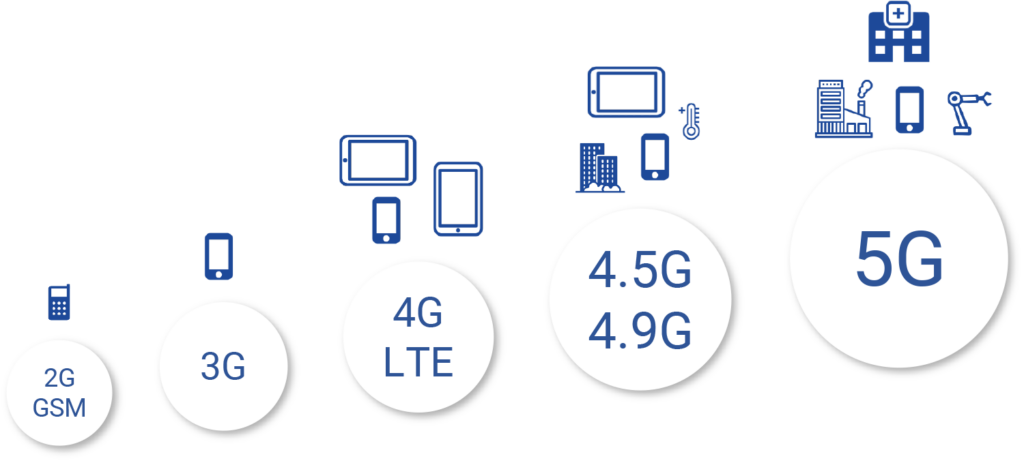
Benefits and Potential of 5G
5G offers:
- Faster speeds and ultra-low latency
- Greater device connectivity and network capacity
- Support for real-time applications such as autonomous vehicles, smart cities and telemedicine
- Enhanced IoT capabilities, industrial automation and immersive AR/VR experiences
- With increased capacity, reliability and performance, 5G is set to transform industries and reshape everyday life.
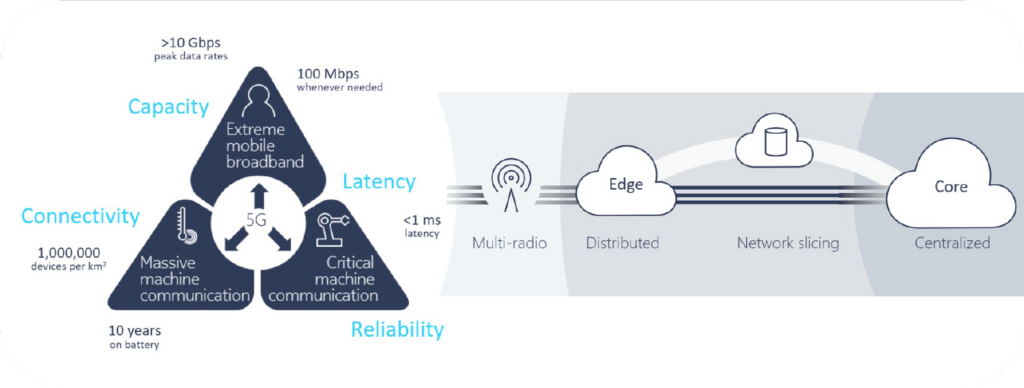
5G vs 4G – Enabling the Next Generation of Connectivity
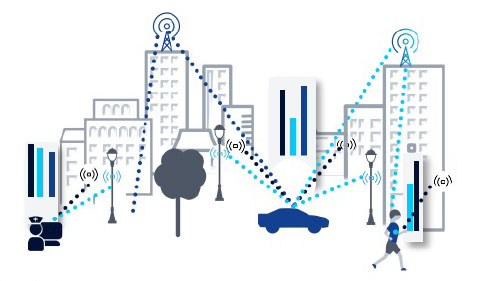
5G
Multi-Carrier Aggregation
4G
Single-Carrier Connection

5G
Network Slicing
4G
Monolithic Network
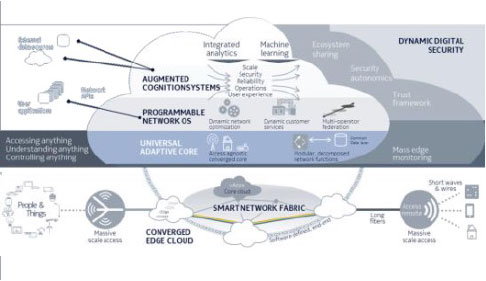
5G
Edge Computing & True Cloud Applications
4G
Basic Cloud Applications
Understanding 5G
NSA (Non-Standalone) vs 5G SA (Standalone)
5G NSA (Non-Standalone)
- Architecture: 5G NSA relies on existing 4G LTE infrastructure, using 4G for control signalling while 5G New Radio (NR) handles data transmission. This approach enables faster deployment by leveraging already established 4G networks.
- Deployment Strategy: NSA serves as a transitional step towards full 5G. It is quicker and easier to deploy because it does not require a completely new network core. Many early 5G deployments have been based on NSA to bring services online rapidly.
- Performance: While NSA delivers significantly higher speeds than 4G, it does not fully unlock the capabilities of 5G. Since parts of the network still depend on 4G LTE, improvements in latency and advanced network features are limited.
- Area of application: NSA is well suited for consumers and businesses seeking faster mobile connectivity and improved network performance. However, it does not fully support advanced 5G applications such as ultra-low latency services and large-scale Internet of Things (IoT) deployments.
5G SA (Standalone)
- Architecture: 5G SA is a complete end-to-end 5G network architecture, incorporating both a 5G Core (5GC) and a 5G New Radio (NR) interface. This enables the full range of 5G capabilities, including network slicing, ultra-reliable low-latency communications (URLLC), and massive machine-type communications (mMTC).
- Deployment Strategy: Deploying 5G SA requires greater investment and a more extensive infrastructure rollout, as it involves building a dedicated 5G core network. In return, it unlocks the full potential of 5G technology and all of its advanced capabilities.
- Performance: 5G SA delivers significantly lower latency, higher data speeds and enhanced reliability. It also supports advanced applications that demand real-time communication and high network performance.
- Area of application: As the long-term evolution of 5G, SA enables next-generation services and innovations such as autonomous vehicles, smart cities, industrial automation, remote surgery, real-time gaming and large-scale IoT networks.
Understanding 5G
Legacy Band vs. 5G NR (New Radio)
Legacy Bands
- Definition: Legacy bands refer to the spectrum bands used by previous generations of mobile networks, including 2G, 3G and 4G (typically frequencies ranging from 700 MHz to 2.6 GHz). When 5G is deployed on these existing bands, the technology is commonly referred to as Dynamic Spectrum Sharing (DSS).
- Performance: Deploying 5G on legacy bands can provide improved speeds compared to 4G, but it does not deliver the full throughput, capacity and low latency associated with 5G. Lower frequencies offer broader coverage but less network capacity.
- Advantages Using legacy bands enables operators to rapidly expand 5G coverage across large geographical areas without requiring significant new spectrum allocations. It provides a practical and cost-effective path towards wider 5G availability while dedicated 5G spectrum is being deployed.
- Challenges: Legacy bands are often heavily utilised, which can limit the performance gains achieved through 5G. As a result, the user experience may not fully reflect the capabilities of next-generation mobile networks.
- Definition: 5G NR (New Radio) is the radio access technology specifically developed for 5G. It operates across low-, mid- and high-frequency spectrum bands, including C-band frequencies around 3.5 GHz and millimetre wave (mmWave) frequencies above 24 GHz. NR is designed to support advanced 5G capabilities such as Enhanced Mobile Broadband (eMBB), Ultra-Reliable Low-Latency Communications (URLLC) and Massive Machine-Type Communications (mMTC).
- Performance: 5G NR, particularly when deployed in mid- and high-band spectrum, delivers significantly higher speeds, lower latency and greater network capacity than legacy bands. For example, mmWave deployments can achieve multi-gigabit data rates, although with shorter range and reduced building penetration.
- Advantages Deploying 5G NR on dedicated spectrum unlocks the full performance potential of 5G. It enables the transformational capabilities promised by the technology across sectors such as healthcare, manufacturing, logistics and smart cities.
- Challenges: Deploying 5G NR, particularly on higher-frequency bands, requires substantial investment in infrastructure and spectrum resources. Due to the shorter range of high-frequency signals, more radio sites and indoor coverage systems are often needed to achieve the desired coverage and capacity.
The Commercial Perspective: 5G NSA vs 5G SA and Legacy Bands vs 5G NR
From a marketing and consumer education perspective, the differences between 5G NSA and 5G SA, as well as Legacy Bands and 5G NR, can be difficult for the average user to understand. This is how these technologies are typically presented:
5G NSA: Marketed as 5G with an emphasis on faster speeds and improved coverage compared to 4G, even though it may not deliver the full range of 5G capabilities. Operators typically focus on enhanced performance and a better user experience.
5G SA: Often promoted as “true 5G” or “full 5G,” highlighting next-generation performance, ultra-low latency and advanced capabilities designed for future applications and services.
Legacy Band 5G: Marketed as 5G with broader coverage, providing improved connectivity across larger geographical areas, although it may not achieve the highest speeds or capacity available with dedicated 5G spectrum.
5G NR (New Radio): Positioned as the most advanced form of 5G technology, focusing on maximum speed, minimal latency and premium user experiences. It is often associated with urban deployments, enterprise solutions and specialised applications.
The key distinction lies in the underlying technology and the capabilities it enables. NSA provides a faster and more accessible path to 5G, but remains a transitional solution. In contrast, SA and 5G NR represent the future of mobile communications, delivering the ultra-fast speeds, low latency and advanced functionality required to unlock the full potential of 5G.
What Is Private 5G?
Private 5G is a dedicated mobile network deployed within a specific area, such as a factory, campus, hospital or industrial facility. Unlike public mobile networks, a Private 5G network is owned and operated by an organisation or service provider to meet specific operational requirements. Private 5G uses 5G NR (New Radio), the global standard for 5G wireless communications, delivering significant improvements in speed, latency, reliability and capacity compared to 4G LTE.
When deploying a Private 5G network, it is crucial to identify the services and applications the network will support. These requirements directly influence the network design, architecture and overall performance.
Network Design and Configuration:
- Different applications, such as IoT devices, video streaming, voice communications and industrial automation, have unique requirements for bandwidth, latency and reliability.
- Understanding these requirements enables the effective use of network slicing, where dedicated virtual networks are created and optimised for specific applications and workloads.
Spectrum Allocation
- Service requirements influence the choice of frequency bands. Higher frequencies may be required for applications demanding high data throughput, while lower frequencies may be more suitable for wider coverage areas and lower data-rate applications.
Quality of Service (QoS)
- Voice over New Radio (VoNR) requires extremely low latency and high reliability to deliver clear and uninterrupted voice communications. By correctly prioritising voice traffic, the network can ensure consistent call quality and a superior user experience.
Security Considerations:
- Different services have different security requirements. Voice services, IoT devices and critical business applications may require varying levels of protection, encryption and network isolation. Understanding these requirements allows the implementation of appropriate security measures from the outset.
Cost Management:
- Clearly defining service requirements helps avoid unnecessary complexity and over-engineering. This ensures that network resources are used efficiently while keeping deployment and operational costs under control.
Compliance and Regulatory Requirements
- Certain applications, particularly those involving sensitive or regulated data, may be subject to strict compliance requirements. Understanding these needs early in the planning process helps ensure that the network meets all relevant regulations and industry standards.
- Selecting the Right Core Network Provider
- Once the service requirements have been identified, the appropriate 5G Core provider can be selected. Not all core network vendors support the same features and services, making this a critical decision in the design process.
- For example, if the network must support Voice over New Radio (VoNR), the solution should be optimised for:
- Low latency to enable real-time communications
- High reliability to maintain uninterrupted voice quality
- Seamless handover between 5G and 4G networks to ensure continuous coverage
- By identifying these requirements during the planning phase, organisations can ensure that their Private 5G network delivers the expected performance while effectively supporting critical business operations.
Find out more about
Mobile coverage indoors
Mobile coverage in car parks/tunnels
Mobile coverage in vehicles
Want to know more?
Do you have any questions about our products and services?
Or would you like to find out what we can do for the mobile coverage in your working environment?
Enter your question here and we’ll get back to you as soon as possible.